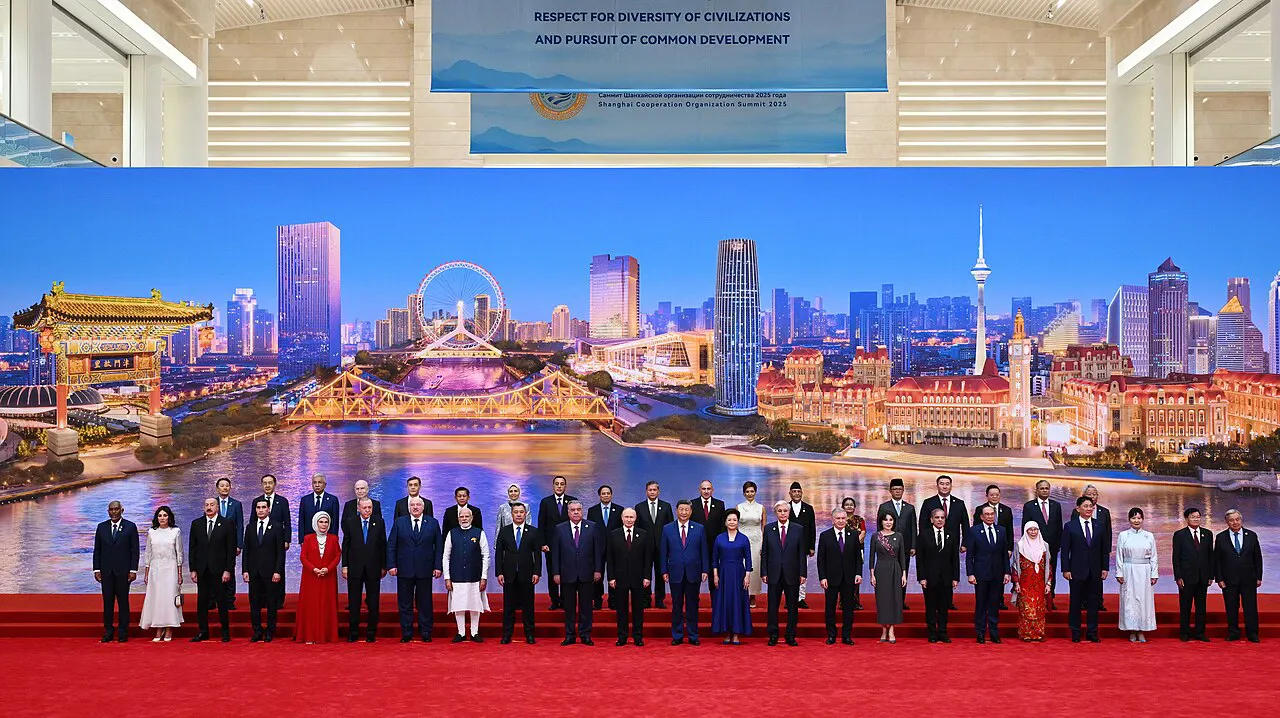
A group photo of the heads of state and government and their spouses on 31 August 2025 at the Tianjin Meijiang International Convention and Exhibition Center. CC BY 4.0. Source: Wikimedia Commons.
For more than two decades, the Shanghai Cooperation Organisation (SCO) lingered in the margins of Western coverage—a Eurasian acronym that sounded bureaucratic, not dramatic. But in September 2025, as leaders gathered in Tianjin to mark the group’s 25th anniversary, the world could no longer look away. What was once dismissed as a “talk shop” has become one of the most consequential laboratories of multipolarity, finance, and security—an institution whose contradictions may prove as influential as its ambitions.
A Club No One Took Seriously
When the SCO was founded in 2001 by China, Russia, Kazakhstan, Kyrgyzstan, Tajikistan, and Uzbekistan, it looked unthreatening. The West had its NATO, its EU (European Union), its G7 (Group of 7). The SCO was Central Asian, niche, and—critics said—paralyzed by consensus. Even after India and Pakistan joined in 2017, Western coverage rarely went beyond clichés: a “photo-op forum,” a “bureaucratic shell,” or “China’s NATO in waiting.”
The dismissiveness missed the point. By geography and demography, the SCO is vast: today it stretches from Belarus to Beijing, Iran to India, covering 42 percent of humanity and a third of global output in purchasing power terms. More importantly, it offers members a political bargain Western institutions rarely did: no conditionality, no preaching, no litmus tests. That sovereignty-first ethic is precisely what has given it durability.
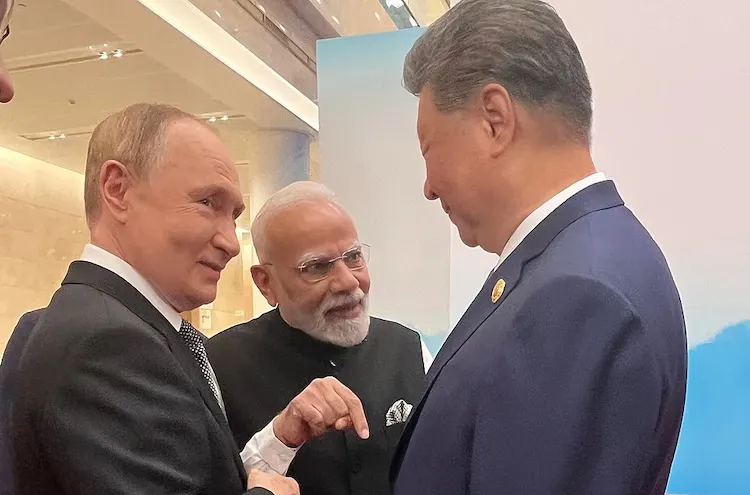
President Vladimir Putin, Prime Minister Narendra Modi and President Xi Jinping discussing at SCO Summit. Source: Indian Prime Minister’s Office..
Scene in Tianjin
Tianjin, China’s bustling port city on the Bohai Gulf, is not Beijing’s political theatre or Shanghai’s commercial showcase. Yet in early September 2025, it briefly became both. Neon-lit skyscrapers framed the summit venues, cordoned streets carried motorcades past banners proclaiming “Shared Destiny, Shared Future,” and the air outside the main hall mixed the humidity of late summer with the sharp scent of fresh paint from hurried renovations.
Inside, the choreography was meticulous: soldiers in crisp uniforms saluted as delegations filed past, translators whispered urgently into headsets, and aides fanned out with thick briefing folders embossed in gold. Cameras clicked when leaders shook hands, but the more telling moments came in the pauses: Xi Jinping leaning toward Vladimir Putin with a hushed aside, Narendra Modi maintaining his careful smile as he greeted both men in quick succession, Iran’s president gesturing animatedly to his Central Asian counterparts. The summit floor felt like a microcosm of Eurasia itself—crowded, multilingual, at once ceremonial and raw—an atmosphere of pageantry edged with unease, where every gesture carried diplomatic weight.
From Background Noise to Frontline
The September 2025 Tianjin summit marked a turning point. Leaders unveiled the Tianjin Declaration, a sprawling document spanning security, finance, technology, and culture. On paper, it read like the usual multilateral boilerplate. In substance, it was something else entirely: an inflexion point where the SCO shifted from a forum of coordination to a project of institution-building.
China pushed—and Russia grudgingly agreed—to launch an SCO Development Bank, issue joint bonds, and create payment infrastructure insulated from Western sanctions. Iran’s first full summit as a member lent urgency: under bombardment by U.S. and Israeli forces in the summer war, Tehran arrived in Tianjin as proof of what happens when sovereignty collides with Western interventionism.
For K.M. Stokes, a political theorist of complexity, the Declaration is less a blueprint than a “symptom of breakdown”—an attempt by Eurasian states to stabilize a world where every move spawns new contradictions. The SCO, he argues, has become a “laboratory of metamorphosis,” where actions intended to reduce risk generate fresh uncertainties. That perspective turns the SCO from an afterthought into one of the most fascinating experiments in global governance.
Multipolarity: Project and Paradox
The Tianjin Declaration champions a “fairer and more representative multipolar world.” In practice, multipolarity is both a source of emancipation and a cause of fragmentation. It frees states from U.S. dominance but risks locking them into rival spheres.
Case study: India’s hedging. At Tianjin, Prime Minister Narendra Modi called for respect of sovereignty but declined to endorse China’s Belt and Road Initiative. For India, the SCO serves as a platform to engage with Central Asia and manage Pakistan, while also acting as a buffer against China. That ambivalence strengthens the SCO by keeping adversaries in dialogue—yet destabilizes it by blocking deeper integration.
Meanwhile, Russia frames multipolarity as a survival strategy—an existential counter to NATO. China sees it as inevitable: an orderly transition to a Sinocentric Eurasia. Iran invokes it as defiance against regime-change wars. Central Asian states invoke it to mean something simpler: breathing space between great powers. Each interpretation mirrors the contradictions of the whole.
Reform and Recursion
The SCO’s call to reform the UN, IMF, and World Bank follows a familiar script: inclusion, equity, representation. However, as Stokes notes, this is a recursive dynamic: demanding reform both legitimizes and delegitimizes the institutions. The IMF, for example, absorbs criticism by offering modest voting-share adjustments—enough to appear responsive, but not sufficient to alter control.
If reforms succeed, SCO members gain a seat. If they fail, the bloc doubles down on building alternatives. Either way, the process exceeds intent. What looks like a policy demand is in fact a feedback loop, one that accelerates the SCO’s institutional growth.
The Security Core: Ecology of Antagonisms
Security has always been the SCO’s backbone. Its Regional Anti-Terrorist Structure (RATS) in Tashkent coordinates watchlists, intelligence, and counter-terrorism exercises. The bloc’s “Peace Mission” drills—featuring armoured units, airpower, and urban counter-insurgency—may not match NATO spectacles. Still, they foster habits of cooperation among militaries that otherwise rarely train together.
Yet securitization is double-edged. By condemning the U.S.-Israeli war on Iran, the Tianjin Declaration framed sovereignty as stability. But in doing so, it heightened antagonism with Washington, entrenching the very confrontation the SCO fears. Complexity thinking helps here: order and disorder are entwined. Crackdowns on extremism can breed resistance; counter-terror operations can radicalize as much as they suppress.
Case study: Afghanistan. After the U.S. withdrawal, the SCO became the only platform where all stakeholders—China, Russia, India, Iran, and Central Asia—sat at one table. Yet their approaches diverge: China wants stability to secure Belt and Road projects; Russia fears drug flows; India worries about terror networks. The SCO’s Afghanistan working groups manage these anxieties but cannot resolve them. That management, however imperfect, may be the SCO’s real achievement.
Economic Ambitions: Parallel Systems
In Tianjin, economic integration took center stage. The proposed SCO Development Bank would fund cross-border infrastructure. Local-currency settlements aim to circumvent the use of the dollar. Energy cooperation—long gestating in the idea of an “Energy Club”—received new momentum with Iran’s entry and the Gulf states as dialogue partners.
But building alternatives creates fresh risks. Currency settlements may reduce sanctions exposure, but they face liquidity shortages and convertibility traps. Parallel systems risk fragmenting global finance into rival blocs.
Case study: Kazakhstan. Its economy is tied both to China’s Belt and Road and to Western investment. For Astana, SCO mechanisms offer diversification, but too much dependence on the yuan finance could undermine its autonomy. The SCO gives it bargaining power—yet also forces it to juggle contradictions.
Sovereignty: Ethic and Blind Spot
Normatively, the SCO insists on sovereignty and non-interference. This appeals to members weary of Western “double standards.” Yet sovereignty cuts both ways: it shields states from intervention but can obscure abuses within.
The Tianjin Declaration’s rejection of “double standards” in human rights reflects this ethic. For members, sovereignty is a shield against what they see as politicized Western critiques. For outside observers, it risks being a blank cheque for repression. Complexity demands holding both truths at once.
Technology: The New Frontier of Uncertainty
Beyond politics and finance, Tianjin ventured into AI, cyber, and space. Here, the SCO seeks to shape the standards of emerging technologies—digital sovereignty, satellite constellations, cyber protocols.
But technological futures are unpredictable. Data localization can empower national control—or entrench dystopian surveillance. Space cooperation can advance peaceful exploration—or escalate militarisation. The SCO recognizes uncertainty but embraces it as a method: building flexible, metastable systems that can adapt to shocks.
Case Study: Russia-China Tech Ties. Under sanctions, Moscow is deepening its reliance on Chinese digital platforms. This bolsters SCO narratives of self-reliance but raises fears of over-dependence. What appears to be resilience may actually sow new vulnerabilities.
Culture and Civilization: Unity Through Diversity
Soft power was not absent in Tianjin. The Declaration highlighted tourism flows, educational exchanges, and cultural festivals as vehicles of Eurasian identity. For the SCO, cultural pluralism is both a shield and a spear: a shield against Western universalism, a spear to project its own narrative of “unity through diversity.”
But cultural identity is also double-edged. It can encourage openness—or harden into ideology. As with finance and security, cultural politics in the SCO is less about harmony than about managing tensions.

Institutional Metamorphosis
Perhaps the most significant reform was institutional: merging the categories of “observer” and “dialogue partner” into a single “partner” status. On the surface, it streamlined bureaucracy. In practice, it signaled consolidation through adaptation. Like living systems, institutions evolve by reorganizing in crisis.
For the SCO, growth brings risk of incoherence; simplification risks rigidity. The challenge is to cultivate enough variety match the complexity of its environment. Whether it succeeds will determine if the SCO becomes a durable pillar or another transient forum.
Western Responses
How will the West respond? Likely with ambivalence—accommodation and resistance at once.
- Finance: The IMF and World Bank may offer symbolic reforms, while SWIFT tightens its grip.
- Norms: Western states will keep branding SCO members authoritarian, even as their own records of surveillance and endless war erode credibility.
- Strategy: Washington and Brussels will court India, ASEAN, and Africa to dilute SCO cohesion, framing partnerships as inclusive alternatives.
- Technology and culture: Expect expanded Western diplomacy in AI, cyber, education, and media to contest Eurasian soft power.
The paradox is that recognition of the SCO’s weight will not translate into genuine power-sharing. The West will acknowledge without yielding, reinforcing the very drive for alternatives that fuels the SCO’s growth.
The SCO as a Complex Act
By the close of the Tianjin summit, one thing was clear: the SCO had crossed a threshold. No longer just a regional coordination forum, it is now an arena where contradictions are institutionalized. Its Declaration was:
- A manifesto of multipolarity, challenging unipolarity while reproducing new dependencies.
- A recursive reform project, seeking to reshape global institutions while legitimizing them.
- A security compact, stabilizing sovereignty while breeding insecurities.
- An economic experiment, constructing alternatives that can destabilize as much as they integrate.
- A cultural project that affirms plurality while risking closure
The SCO’s gamble is high-stakes. It is not about solving contradictions but about living with them—turning Eurasia into a stage where complexity itself becomes institutionalized. For Western policymakers and media, the message is blunt: this is no longer background noise. What happens in SCO corridors—on payments systems, pipelines, counter-terror watchlists, AI protocols, or cultural narratives—will shape the world’s balance of power.
Curtain Call in Tianjin
As the summit in Tianjin drew to a close, the grand hall slowly emptied. Delegations shuffled papers into leather cases, translators slipped off their headsets, and aides collected the last nameplates from the long table. Outside, the city’s streets were already returning to normal—commuters crowding subways, vendors setting out steaming trays of baozi in the humid night air. But in the fading light, the billboards still glowed: “Shared Destiny, Shared Future.”
It was a phrase both aspirational and unsettling, the kind of slogan that outlasts the summit itself. The leaders’ parting handshakes—some warm, others perfunctory—seemed to capture the SCO’s essence: a fraternity of necessity, full of contradictions, bound together less by shared ideology than by the recognition that the old order is slipping. One image lingered: Narendra Modi clasping Vladimir Putin’s hand as Xi Jinping looked on, an uneasy triangle frozen by photographers into a moment of solidarity. Another: the group photo, a row of leaders stretching from Eastern Europe to East Asia, staged against a backdrop of Tianjin’s flags and lights.
Neither image told the whole story, but together they hinted at the SCO’s paradox—unity in diversity, cohesion in contradiction. Tianjin offered no neat solutions, but it staged the contours of a new era. And as the motorcades pulled away into the haze, one thing was sure: the SCO, long ignored in the West, would not remain in the background any longer.