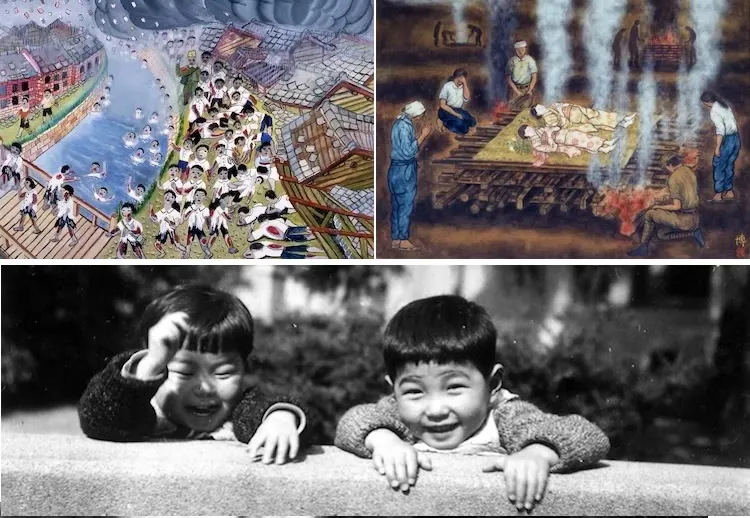
Eighty years ago, on 6 and 9 August 1945, the cities of Hiroshima and Nagasaki were obliterated by atomic bombs dropped by the United States—the only time nuclear weapons have been used in war. The blasts killed between 150,000 and 246,000 people, including an estimated 38,000 children—infants, toddlers, and teens whose lives ended in a single flash.
Today, their memories are being reclaimed and amplified—not as abstract statistics, but as moral imperatives demanding action.
A Digital Tribute for Innocents Lost
In June, the 2017 Nobel Peace Prize winner, International Campaign to Abolish Nuclear Weapons (ICAN), launched a digital memorial featuring over 400 detailed profiles of children killed in the bombings. Many stories, such as that of 4-year-old Kishida Eiji, have been made public in English for the first time. Eiji’s crucifixion in flame, begging for water, was witnessed by his aunt, Setsuko Thurlow, who holds his image as living proof of nuclear carnage. Another profile tellingly portrays SASAKI Sadako, who succumbed to leukaemia after folding more than 1,000 origami cranes in the hope of healing.
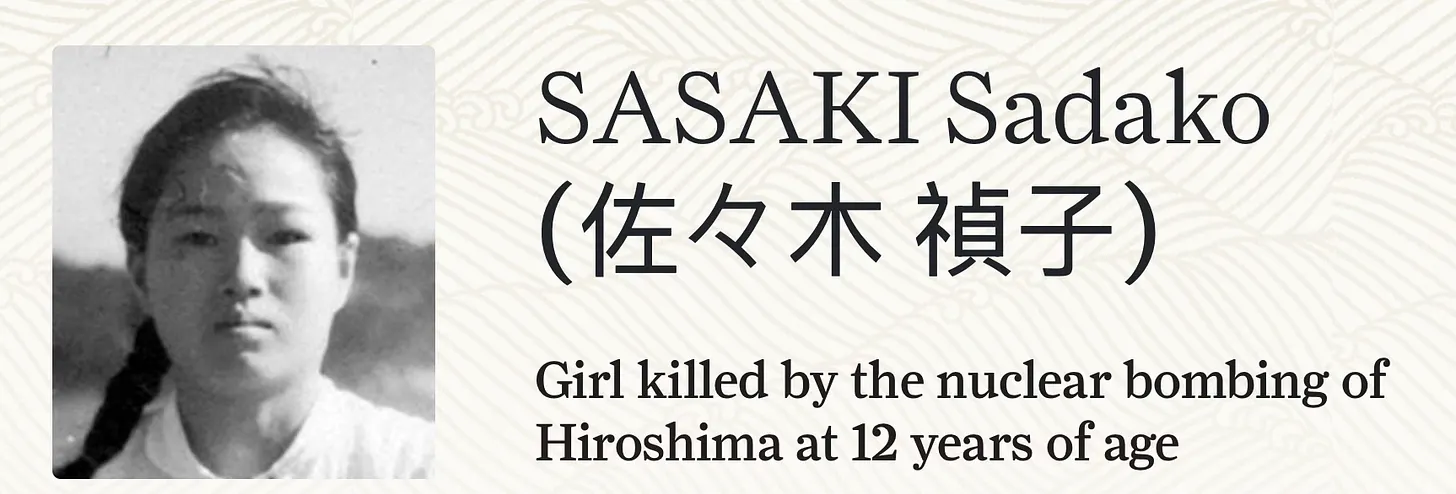
ICAN’s memorial invites visitors to fold their cranes and send them to world leaders, urging them to support the Treaty on the Prohibition of Nuclear Weapons (TPNW). Though 94 countries have signed it, no nuclear-armed state has joined—yet its moral force is growing.
A Nuclear World Re-Emerges
This digital tribute coincides with the alarming modernization and expansion of the nuclear stockpile. According toSIPRI, by January 2025, the world possessed 12,241 nuclear warheads, with 9,614 in active military stockpiles and around 2,100 on high “operational alert” status—held mainly by the U.S. and Russia.
The downward trend in nuclear numbers during the Cold War era has reversed. The U.S. and Russia—which together hold nearly 90 per cent of the world’s arsenal—are modernizing with investments spread over decades, including a U.S. modernization program estimated at $1.5 trillion (SIPRI). China’s arsenal has grown from around 500 to 600 warheads and may double to 1,000 by 2030. India (180), Pakistan (170), Israel (90), North Korea (50)—all are modernizing. The U.K., France, and China also continue upgrades.
Other nuclear states exist on the sidelines. Estimates suggest that six NATO countries, including Germany and Italy, host U.S. nuclear weapons on their territory. Russia may have discreetly deployed weapons in Belarus.
These figures reflect a world where nuclear threats are increasing even as nuclear doctrine grows murky. As SIPRI warns, oversight and regulation of automated decision-making are urgently needed to prevent an accidental nuclear crisis.
Paths to Lowering the Risk
In this fraught environment, Soka Gakkai International (SGI)—a global Buddhist peace movement—proposes two urgent reforms:
1. No First Use (NFU)
NFU would commit nuclear states to never use nuclear weapons unless first attacked with them. China is the only nuclear-armed country to have an unconditional NFU policy. India maintains a policy of NFU with exceptions for a response to chemical or biological attacks.
France, North Korea, Pakistan, Russia, the United Kingdom and the United States maintain policies that permit the first use of nuclear weapons in a conflict. Israel does not acknowledge the existence of its nuclear arsenal so has no publicly known position
In the U.S. Congress, bills like the Restricting First Use of Nuclear Weapons Act (H.R. 669/S. 192, 2025) would prohibit funding for first-use strikes without a congressional declaration of war (Congress.gov). Earlier bills, such as theNo First Use Act introduced in 2021 and 2023 by Rep. Adam Smith (D-WA) and Sen. Elizabeth Warren (D-MA), similarly seek to enshrine NFU in law (adamsmith.house.gov). Despite bipartisan sponsorship and widespread public support, the bills have gone nowhere—stymied by strategic arguments and alliance politics.
But SGI argues for a renewable, one-year NFU moratorium, perhaps initiated during the 2026 NPT Review Conference—a signalling mechanism designed to restore the “nuclear taboo,” reduce miscalculation risks, and create diplomatic space for trust-building.
2. Nuclear War Prevention Centre
SGI’s second proposal is the establishment of an international center dedicated to the prevention of nuclear war. The pledge to adhere to the principle of No First Use would inevitably require the nuclear-weapon and nuclear-dependent states to fundamentally reconsider their national security policies.
“The centre could be staffed by top-level military, political and economic experts, and would collect and analyse a wide range of information through state-of-the-art computers and satellite communication networks, quickly identifying critical situations and taking steps to de-escalate.”
This model was briefly tested in 1998, when the U.S. and Russia established cooperation to mitigate fears around the Y2K transition. SGI proposes locating the Centre in a Nuclear-Weapon-Free Zone —Latin America and the Caribbean, the South Pacific, Southeast Asia, Africa and Central Asia—with support from the United Nations.
Today, the U.S. stands at a critical hinge point:
- The 2022 Nuclear Posture Review reaffirmed ambiguity about first use, citing extended deterrence and alliance networks, while stopping short of NFU.
- Congress is approving the modernization of the nuclear triad: sea-, air-, and land-based systems with an estimated$60 billion annual spend through 2030 (fas.org , SIPRI).
- The No First Use Act has stalled and remains politically marginal—despite a majority of Americans supporting it in multiple polls.
- The U.S. has refused to participate in TPNW meetings. Yet attending as an observer could signal renewed engagement with the growing global moral consensus—and survivors like Setsuko Thurlow.
By the same token, the U.S. could champion funding for arms-control and prevention systems—far cheaper but potentially far more impactful than weapon upgrades.
Why It Matters—Now
Globalities are converging in ways that elevate nuclear risk:
- Russia’s deployment of tactical weapons in Belarus, Kaliningrad, and Kamchatka; Britain and France forming a joint deterrence pact; ongoing tensions in the Middle East (The Guardian).
- AI-enhanced weapons systems that enable rapid, possibly autonomous nuclear launch decisions, heightening the risk of miscalculation—perhaps faster than any human check
(The Times). - The ongoing collapse of arms-control frameworks: New START ends in 2026, while INF and Open Skies are gone.
- The high-alert status of upwards of 2,100 deployed warheads, primarily held by the U.S. and Russia
(The Times,Reuters).
None of these data exist in isolation—they are tied to memory of Hiroshima and Nagasaki, immortalized in Eiji’s cry for water and Sadako’s cranes. They reveal a world on the edge, where remembrance must translate to restraint.
What the U.S. Must Do
As the only nation to have used nuclear weapons in conflict, the U.S. bears a unique historical and moral responsibility. Commemoration alone is insufficient. Leadership is required—and it can start with pragmatic steps:
No First Use: Support or co-sponsor the Restricting First Use Act, revive NFU as legislation, thus reducing miscalculation, restoring taboo, and building trust.
Nuclear War Prevention Center: Allocate modest funding for international early-warning, crisis coordination infrastructure to prevent accidents, and maintain peace during crises.
TPNW Engagement: Attend as observer, participate in meetings, and continue survivor testimony to signal the U.S. openness to humanitarian norms and global leadership.
These steps are inexpensive, reversible, and morally coherent with U.S. commitments under the Non-Proliferation Treaty (NPT), which mandates negotiations toward disarmament in Article VI.
The Echoes of Innocence
On the very sites of Hiroshima and Nagasaki, survivors like Setsuko Thurlow and activists from Nihon Hidankyo—recent recipients of the 2024 Nobel Peace Prize—continue to urge a world less touched by nuclear violence. Thurlow’s banner, listing the names of the 351 classmates killed alongside her, reminds us: each individual was known, loved, and mourned.
Their lessons are vital for a world on the brink. As Senji Yamaguchi implored at the UN in 1982: “No more Hiroshima. No more Nagasaki. No more war. No more hibakusha.”
Today, half a century—two generations—later, it is the turn of global leaders to heed that plea. The hearts of those children are not buried—they aren’t even silent.
Collage featuring a drawing by KIMURA Hideo, who was 12 years old at the time of the Hiroshima attack (courtesy of the Hiroshima Peace Memorial Museum, left); artwork by MATSUZOE Hiroshi depicting Minako and Chikako being cremated (courtesy of the Nagasaki Atomic Bomb Museum from Nagasaki Shimbun, right); and an image provided by the Children’s Peace Memorial (bottom). Credit: Nastranis.