For over three decades, the world took cautious steps away from the brink of nuclear catastrophe. Warheads were dismantled, treaties were signed, and deterrence was managed through diplomacy. That era is now over.
According to new findings from the Stockholm International Peace Research Institute (SIPRI), global nuclear arsenals are once again growing, and nearly all nine nuclear-armed states are upgrading their stockpiles with newer, deadlier technologies.
The age of disarmament is giving way to a new arms race—more fragmented, faster, and less constrained by rules than the last. This is not just an arms buildup. It’s a breakdown of the international order that kept nuclear war at bay for a generation.
SIPRI’s 2025 Yearbook estimates that the total number of nuclear warheads globally stands at roughly 12,241. Of these, over 9,600 are in military stockpiles, with nearly 4,000 already deployed on missiles or with active units. Approximately 2,100 are on high operational alert, ready to launch within minutes. Most of these belong to Russia and the United States. But China may now be preparing to adopt a similar posture.
For decades, global numbers were trending downward. The United States and Russia, the two largest nuclear powers, have steadily reduced their stockpiles through agreements such as START and New START. But that progress is faltering. The dismantlement of retired warheads has slowed. Modernization has accelerated. Treaties have expired or been abandoned.
Hans M. Kristensen, an expert on nuclear weapons and a senior associate fellow with SIPRI’s Weapons of Mass Destruction Programme, put it bluntly: “The era of reductions in nuclear weapons is coming to an end.” Kristensen is also the Director of the Nuclear Information Project at the Federation of American Scientists (FAS).
It’s not hard to see why. The war in Ukraine has re-weaponized the threat of nuclear use. North Korea openly calls for an “unlimited” expansion of its nuclear arsenal. Israel, while still silent on its capabilities, is reportedly upgrading its missile systems.
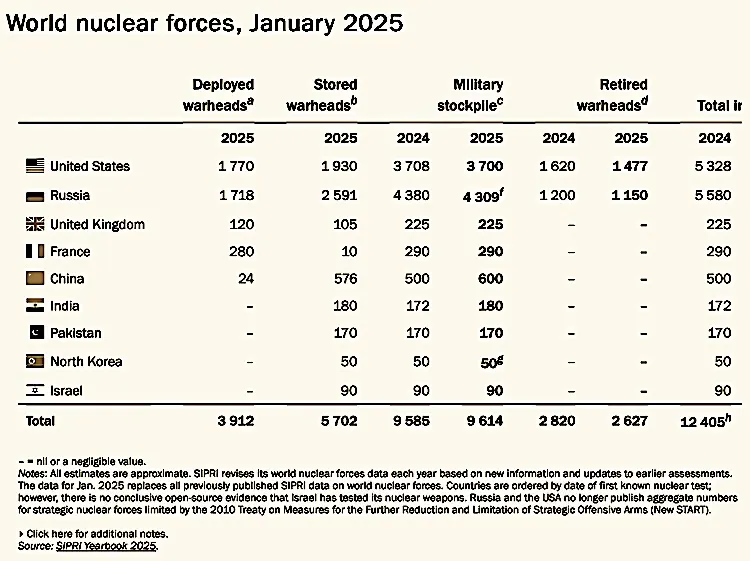
SIPRI estimates that China currently has a minimum of 600 nuclear warheads. China’s nuclear arsenal has been increasing at a rate of approximately 100 new warheads per year since 2023. By January 2025, China had either completed or nearly completed around 350 new ICBM silos in three large desert fields in the northern part of the country and three mountainous regions in the east.
Depending on its strategic decisions, China may have a number of intercontinental ballistic missiles (ICBMs) comparable to those of either Russia or the USA by the end of the decade. Even if China reaches the estimated maximum of 1500 warheads by 2035, this would still be about one-third of the current nuclear stockpiles of Russia and the USA.
The United States is revamping its nuclear posture. A massive modernization program is underway involving new submarines, missiles, bombers, and warheads. Yet delays, ballooning costs, and Congressional infighting threaten its timeline. Analysts warn that Washington may soon face hard decisions: whether to scale back its ambitions or accept higher strategic risks.
Russia, too, is updating its arsenal despite a failed test of its much-touted Sarmat ICBM last year and slower-than-expected progress on other systems. While Moscow has not yet delivered on earlier promises to expand its tactical nuclear arsenal, it continues to refine its delivery capabilities. It may reload decommissioned silos in the years ahead.
India has reportedly expanded its nuclear arsenal slightly in 2024 and continued the development of new nuclear delivery systems. India’s new ‘canisterized’ missiles, which can be transported with mated warheads, may have the capability to carry nuclear warheads during peacetime and potentially multiple warheads per missile once operational. Pakistan has also continued to develop new delivery systems and accumulate fissile material in 2024, indicating that its nuclear arsenal may expand over the coming decade.
In early 2025, tensions between India and Pakistan briefly spilled over into armed conflict.
“The combination of strikes on nuclear-related military infrastructure and third-party disinformation risked turning a conventional conflict into a nuclear crisis,” said Matt Korda, Associate Senior Researcher with SIPRI’s Weapons of Mass Destruction Programme and Associate Director for the Nuclear Information Project at FAS. “This should act as a stark warning for states seeking to increase their reliance on nuclear weapons.”
Despite the illusion of deterrence, the reality is this: nuclear weapons do not prevent war. They complicate it. They raise the stakes. They reduce the margin for error. And they amplify the risks of accidents, miscommunication, or impulsive political decisions.
Meanwhile, the mechanisms of nuclear restraint are collapsing. The New START treaty—the last remaining agreement limiting Russian and U.S. strategic weapons—will expire in February 2026. There are no negotiations underway to extend or replace it. The United States has insisted that China be included in any future framework. China has flatly refused. Russia, under President Putin, shows no interest in renewing any form of bilateral arms control.
The absence of treaties is bad enough. But the proliferation of destabilizing technologies—artificial intelligence, cyber warfare, missile defence, space-based weapons, and quantum computing—makes today’s nuclear risks even more volatile than during the Cold War.
As Dan Smith, SIPRI’s Director, warns: “We are entering a new arms race that is more unpredictable and more dangerous than the last.” The old formulas of arms control, based on numerical parity and verification regimes, no longer apply in a world where decision-making is accelerated by machine learning and deterrence is shaped by digital warfare.
What happens when nuclear early-warning systems are hacked? When AI misidentifies a satellite launch as an attack? When misinformation spreads faster than diplomacy can correct it?
This is not science fiction. These are fundamental questions facing policymakers today. And yet, too little is being done to prepare for them.
Worse still, interest in nuclear sharing is on the rise. Russia and Belarus claim to have deployed nuclear weapons on Belarusian territory. Some NATO states have indicated they’re open to hosting more U.S. weapons. French President Emmanuel Macron has renewed his call for a “European dimension” to France’s deterrent. In East Asia and the Middle East, debates over indigenous nuclear programs have gained political traction.
In this context, it’s worth repeating an uncomfortable truth: possessing more nuclear weapons does not necessarily mean greater security. They mean more risk. More targets. More scenarios for escalation. There are more ways for a miscalculation to become a catastrophe.
The world needs to stop sleepwalking into a second nuclear age. The return of great-power competition does not have to mean a return to nuclear brinkmanship. But it will—unless governments act now.
This means reopening arms control talks, not closing them. It means investing in diplomacy, not just deterrence. It means building guardrails for new technologies before they outpace human control and oversight. And it means resisting the false comfort of nuclear nationalism—the idea that more warheads make a country stronger or safer.
Because if we’ve learned anything from the nuclear age, it’s this: the only way to win a nuclear war is not to fight one.
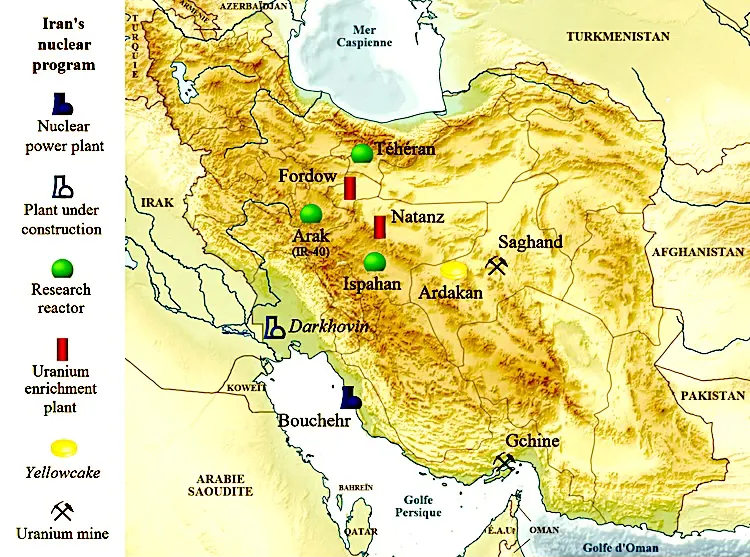
Top image: A map of the main sites of Iran’s nuclear program. CC BY-SA 4.0